








 Comparing cellular delivery mechanisms: Exosomes, viral vectors, and nanoparticles
 03 สิงหาคม 2569
You’ve got a therapeutic candidate that is a high-performer in every in vitro assay, and now you just need to get it into a cell … easy, right? Not. Efficient cellular delivery remains a core bottleneck in therapeutic development. Precious cargo must be protected from degradation, reach the appropriate tissue, enter cells efficiently, and avoid excessive immune activation. While viral vectors and lipid nanoparticles (LNPs) have enabled major clinical advances, each introduces trade offs related to immunogenicity, persistence, or biological relevance.
Exosomes are naturally secreted extracellular vesicles which originate from many cell types (most commonly mesenchymal stem cells or MSCs). They transport proteins, lipids, and nucleic acids via endogenous uptake pathways, playing a central role in paracrine signaling and tissue repair. With intrinsic biocompatibility and the ability to exploit native intracellular pathways, exosomes offer a promising cellular delivery vehicle as compared to synthetic and viral systems.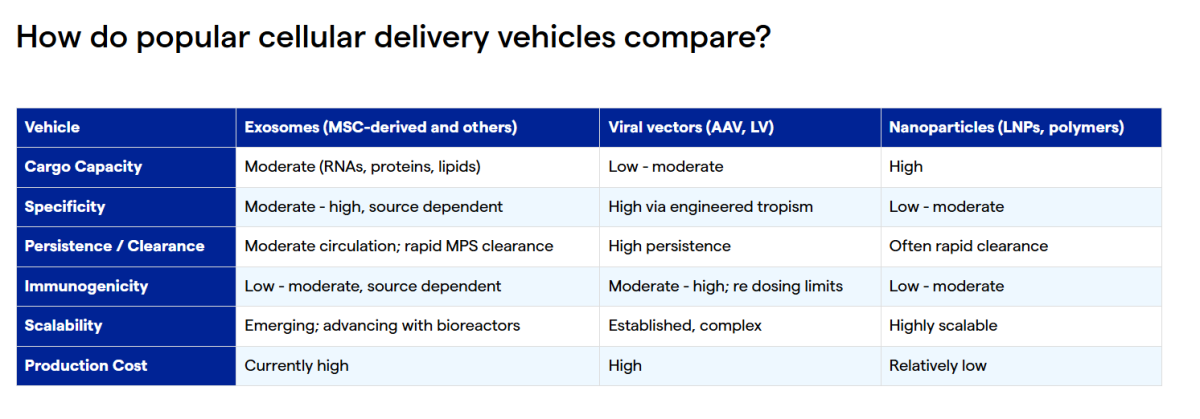
Exosomes have unique biological advantages but face manufacturing and standardization challenges, including heterogeneity and limited yield. In contrast, viral vectors deliver potent and durable expression but with well documented immunogenicity concerns, while nanoparticles trade some evolved benefits for tunability and scalability.
When are exosomes the right choice?
Exosomes are particularly well matched to therapeutic programs where biological signaling rather than forced transfection underpins efficacy. In relation to MSC-based and regenerative applications, exosomes often possess the immunomodulatory and regenerative characteristics of parent cells without the risks associated with live cell delivery.
Exosomes are the most compelling choice when:
- Therapeutic activity depends on multi-factorial biological cues
- Repeated dosing is anticipated
- Cargo is <5 kb
- Low immunogenicity is essential
- Cargo benefits from native intracellular routing
- As scalable manufacturing and characterization platforms mature, exosomes are increasingly viewed not as experimental alternatives, but as purpose built delivery systems aligned with regenerative biology.
Written by Michael
for Scientific Support